
FEMMEfille
The tragic story of Isabelle Caro who rose to fame from Oliviero Toscani's "NO-Anorexia" campaign.
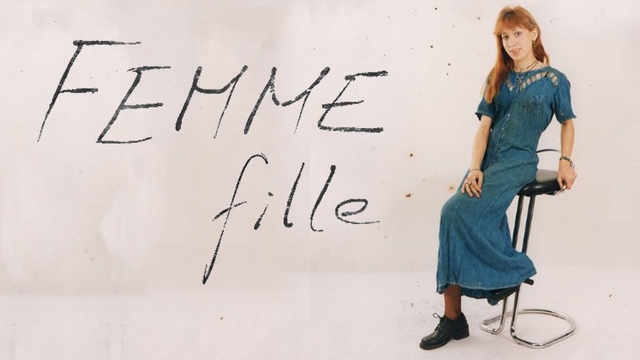 In the fashion world, Isabelle Caro was known as the face of shocking campaign "NO-Anorexia". But what is the story behind the woman whose emaciated body adorned Oliviera Toscani's billboards? Looking above and beyond her illness, this documentary turns back the clock on Isabelle's troubled life and reveals the true desires and ambitions of a young woman struggling to overcome her childhood trauma and enter the adult world.


 "I was mesmerised... the image looked so free." On the screen, a figure skater moves gracefully across the ice, in perfect sync with live violin music. The tape is one of several VHS recordings of TV programmes left behind by Isabelle. Her own dream was to be an actress, however the parts she was offered tended to be determined by her condition: frail, usually sickly women. Terminal cancer patients. What would be her ideal role? "A strong woman, one who fights", she says.
From a young age, Isabelle was strongly drawn to inventing characters. "I started talking to my reflection in the mirror, as if it was another little girl", she writes in her childhood diary. She gives the girl a name: Rebecca. Rebecca is prettier than her and is free to do as what she wants. Isabelle was at this time effectively imprisoned in her home. Her stiflingly protective mother never wanted her little girl to grow up.
When fashion came by chance into Isabelle's life, it appeared to offer her a future on her own terms. But in this world, the model has no control over their own image. "They insisted on seeing bones", she says. She penned an autobiography attempting to tell her side of the story. For the first time, the truth about her childhood came out, along with a revelation: was singer Danyel Gerard, for whom she wrote a song, her real father?
FEMMEfille is a meditation on a troubled life that came to a tragic end. It shows the human side of a woman who came into the public eye because of her illness, and shows that there is much, much more to Isabelle.
LEARN MORE.
"I was mesmerised... the image looked so free." On the screen, a figure skater moves gracefully across the ice, in perfect sync with live violin music. The tape is one of several VHS recordings of TV programmes left behind by Isabelle. Her own dream was to be an actress, however the parts she was offered tended to be determined by her condition: frail, usually sickly women. Terminal cancer patients. What would be her ideal role? "A strong woman, one who fights", she says.
From a young age, Isabelle was strongly drawn to inventing characters. "I started talking to my reflection in the mirror, as if it was another little girl", she writes in her childhood diary. She gives the girl a name: Rebecca. Rebecca is prettier than her and is free to do as what she wants. Isabelle was at this time effectively imprisoned in her home. Her stiflingly protective mother never wanted her little girl to grow up.
When fashion came by chance into Isabelle's life, it appeared to offer her a future on her own terms. But in this world, the model has no control over their own image. "They insisted on seeing bones", she says. She penned an autobiography attempting to tell her side of the story. For the first time, the truth about her childhood came out, along with a revelation: was singer Danyel Gerard, for whom she wrote a song, her real father?
FEMMEfille is a meditation on a troubled life that came to a tragic end. It shows the human side of a woman who came into the public eye because of her illness, and shows that there is much, much more to Isabelle.
LEARN MORE.
WATCH MORE.
JOIN THE DISCUSSION.
 Official Selection, DOK Leipzig, 2014
Official Selection, IDFA Forum, 2012
Official Selection, DOK Leipzig, 2014
Official Selection, IDFA Forum, 2012

